
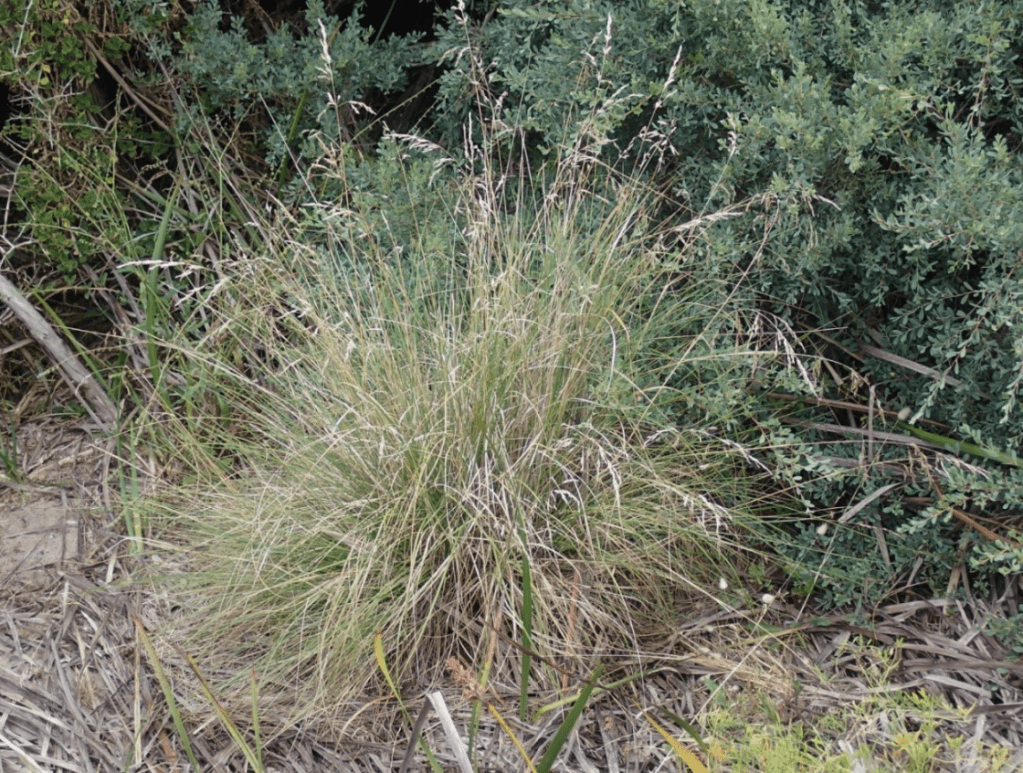
Poa Labillardieri is a tussock grass native to Australia and is common on moist soils throughout southern and eastern Australia including Tasmania. It favours open forest areas, grassy woodland and moister areas on low slopes and valley floors that are frequently wet. The dull green leaf blades have a rough feel, grow up to 80 cm long and are channelled or sometimes flat. The culms (seed heads) are up to 1.2 metres tall and the inflorescence or flowering heads occur in an open pyramid shape up to 25 cm long, from October to February.
It is often used in landscaping due to its graceful arching form. The dense tussocks provide nesting materials and habitat for small animals, reptiles and frogs, and food for birds and caterpillars. Indigenous people used the stems and leaves for string and basket making.
We have included Poas in our creek bank planting as its extensive fine root system helps to stabilise the creek bank and in the event of a flood the Poa will lay flat and recover rapidly once the water recedes.
The genus name is after Jacques Labillardiere, the French naturalist noted for his descriptions of Australian flora. Labillardière was a member of a voyage in search of the La Pérouse expedition. He published a popular account of his journey and produced the first Flora on the region. His name is honoured in many plant and some animal species.
For more information about how you can become a valued volunteer contact us at cluneslandcare@gmail.com
We acknowledge the Dja Dja Wurrung as the traditional
custodians of these lands and waterways.
 Clunes Landcare and Waterways Group